

♫ This is how we do it ♫
Not sure where to start with the risk-based approach? You don't have to. The Northland Transportation Alliance shares how they're making incremental changes, from site-specific risk assessments to handing more control back to contractors, proving that a step change is enough to get the ball rolling.
Get strategic insights delivered monthly. No fluff, just actionable perspectives on the challenges facing business leaders today.

One of the questions we get most as the ISG is ‘How do I get started?’. The good news is, it's easier than you think.
It’s not an all or nothing and you don’t have to go from 0-100 overnight. You don’t have to undertake a full trial, a step change is a simple way to get started. Give it a go!
We thought it’d be a great idea to bring together examples of some of the ways - big and small - people are starting to incorporate a more risk-based approach to TTM into their work.
We’re keen to make this a regular thing, so if you’ve got an example of how you’re moving toward a more risk-based approach to TTM, we’d love to hear from you - email info@ttm-isg.org with your example/s.
In the meantime, we have a few examples from the Northland Transportation Alliance about how they’re incorporating a more risk-based approach to TTM into their work:
Risk Assessment
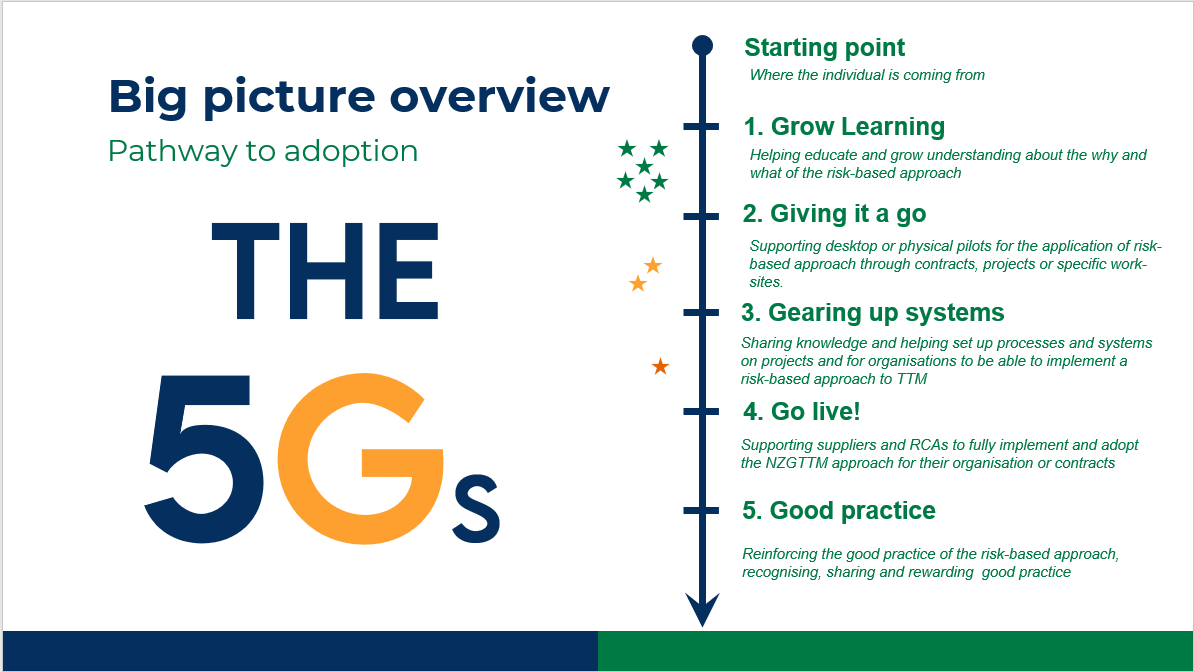
- Site Specific Risk Assessment - NTA has made it a requirement for a site specific risk assessment to be submitted with all traffic management plans. They believe the key is to start and to “Give it a go” – 5Gs. It might not be perfect and they might not get it right first time, but like Shaquille O’Neal said: “Excellence is not a singular act but a habit. You are what you do repeatedly."
- Plan-Do-Check-Act - NTA is challenging contractors to look at sites with a risk-based lens and put their CoPTTM lens to the side. Look at the cones and signs set out – do they have a purpose, do they make sense and are the controls being complied with? If not, review it.
Handing back control to the contractor
- Changes from CoPTTM are highlighted by the contractor, assessed together and accepted and/or changes are agreed.
- Contractors have flexibility to submit TMP forms that suit their needs, not necessarily the NZGTTM or COPTTM templates.
Overlapping Duties
- Bringing the contractor or foreman for the job into TTM discussions when we engage with the STMS on worksites.
Our next steps are:
- TMP Planning Process - Requirement to include details of who was involved in planning meetings and risk reviews in the TMP. Led by the 3Cs – consult, cooperate, coordinate.
- TMP approval by Contractor PCBU - Getting the lead contractor to sign off the TMP before the Corridor Access Request (CAR) is submitted for risk review and Network Access Coordination approval by the CAR team.