


Understanding Risk: Christchurch City Council's NZGTTM Progression
27 May 2026
Risk Assessments in TMP Submissions — From 1 July 2026
From 1 July 2026, all TMPs submitted to Christchurch City Council must include a risk assessment covering proposed impacts and the interface between the physical worksite and regular road users.
Christchurch City Council is asking TTM planners and contracting PCBUs to include only hazards relevant to the RCA review: those affecting the interface between the worksite and road users. Internal PCBU hazards; sunscreen use, plant pinch points within the working space, and similar, belong in the PCBU's own internal risk management plans, not the TMP. Christchurch City Council has noted that including these has become common practice, but it's not appropriate for TMP risk assessments.
What This Looks Like in Practice
In a recent NZGTTM trial, a Christchurch City Council contractor cut their hazard list from four pages to 1.5 pages simply by removing items unrelated to the road user/worksite interface, following a conversation with the client and RCA PCBU. Leaner, more focused submissions benefit everyone, they're faster to review and more meaningful to the people assessing them.
Christchurch City Council staff will review the hazards identified and flag anything that may have been missed. They'll then look at the control measures selected and may ask why higher-level controls weren't considered reasonably practicable. This is an active, two-way process.
Read more here
Good Risk Statements Guidance
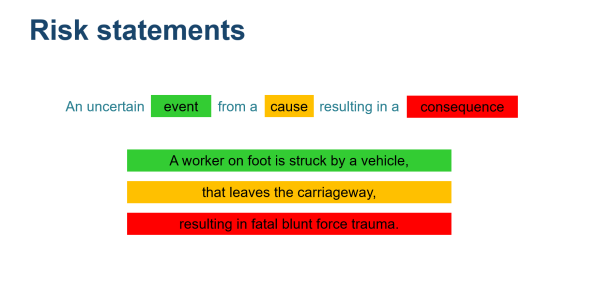
A good risk statement is important as it helps us focus our risk controls on the risk.
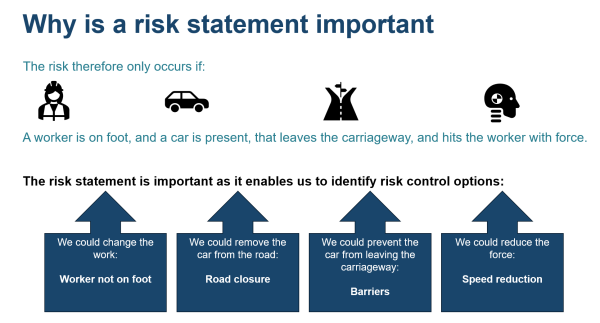
To support our industry evolution and improve our approach to risk controls, NZTA has prepared the following two slides for the roadshow. They are designed to help us structure risk statements to cover the three key elements of a complete risk statement: the people, the event/cause, and the consequence. This helps us identify risk control options for each risk.
There are four risk controls described for the example risk statement in the slides below; there may be more. It is important that when considering the risk controls, the hierarchy of controls model is applied.

TTM ISG | Understanding Risk Series
This is the first article in our Understanding Risk series, where we look at how regulatory and industry developments shape the way risk is defined and managed across the sector. We will continue to follow Council's progress through the NZGTTM transition and share updates as they become available.